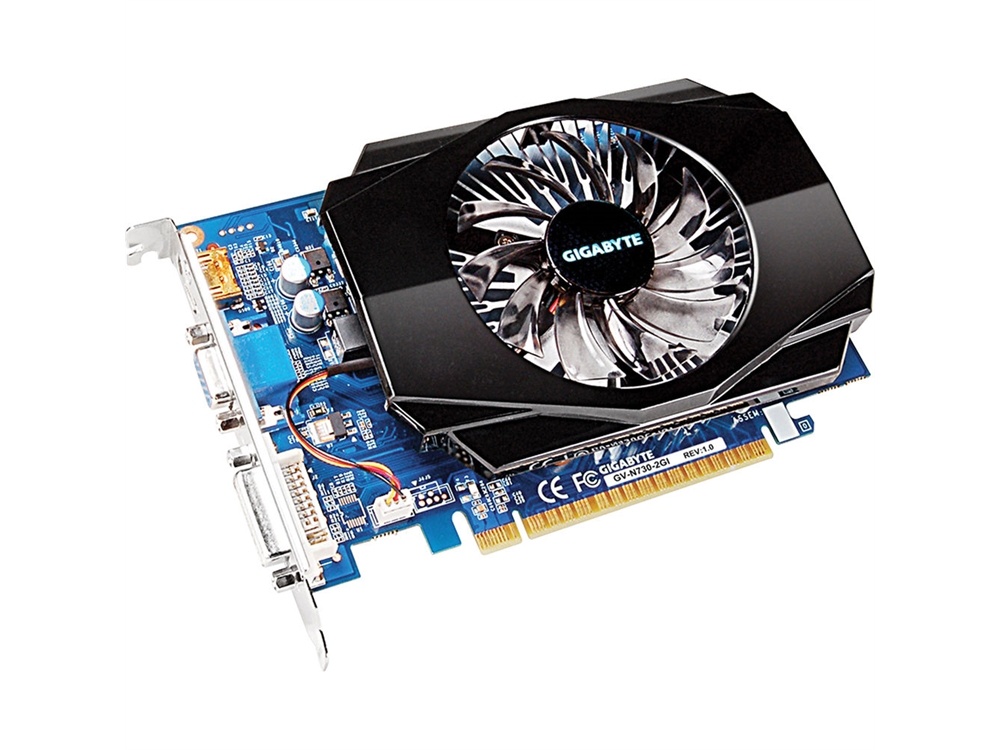




































































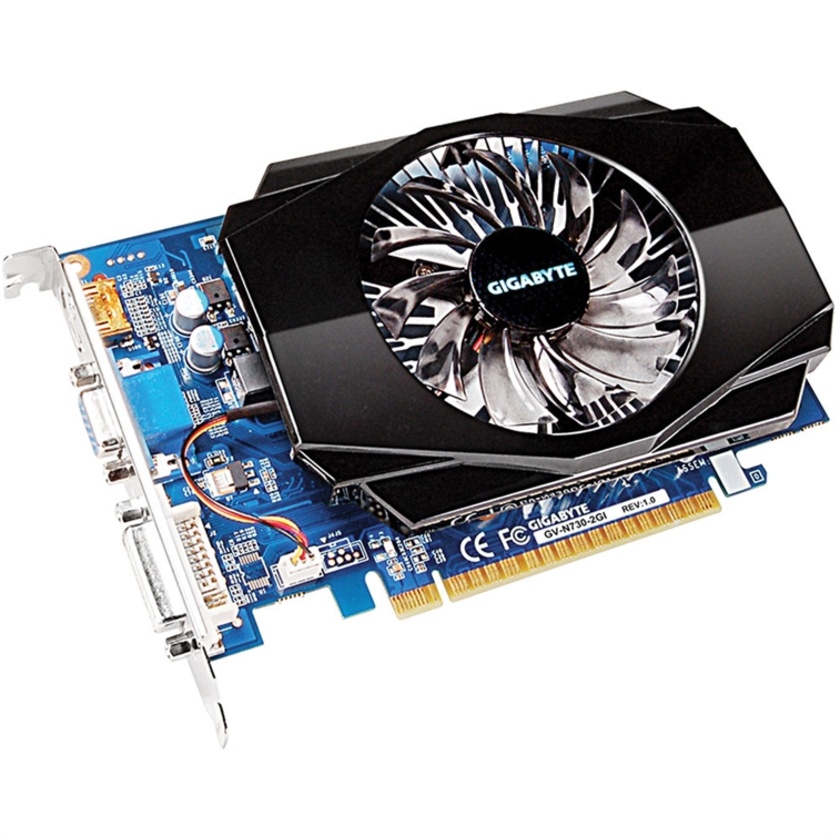
Increase your computer's video performance over integrated graphics with a GeForce GT 730 Graphics Card from Gigabyte . This version of the GT 730 card features 96 CUDA cores clocked in at 700 MHz. The GPU core is connected to the 2GB of DDR3 vRAM with a 128-bit interface. Having a discrete graphics card can also increase the speed of the computer when programmes are accelerated using the GPU cores, freeing up CPU cycles. This card is best suited to high-resolution video playback or light, low-resolution gaming.
Features
CUDA
NVIDIA's parallel computing platform which enables an increase in computing performance by harnessing the parallel nature of GPU processing. CUDA compatible applications can assign intensive parallel computing tasks, such as real-time video rendering, to the GPU to process, freeing up the computer's CPU to run other tasks.
3D Vision Support
When used with a 3D Vision compatible monitor and 3D Vision active-shutter glasses, full-HD resolution images are delivered to each eye. Additionally, with a 3D LightBoost compatible screen, image brightness will be maintained while using the glasses and ghosting will be reduced.
PhysX
NVIDIA's hardware accelerated physics engine computes how objects move in space in real time. Having a physics engine precludes the need for programmes to pre-animate rendered objects which can give an unrealistic "canned animation" feel. The PhysX engine also allows for designers to create more detailed objects, relying on the GPU's processing power rather than a bloated programming back end.
Adaptive V-Sync
NVIDIA's Adaptive Vertical Sync minimises stuttering and tearing by monitoring and adjusting the card's frame rate output. At high frame rates, Adaptive V-Sync is enabled to slow down the output frame rate to prevent tearing as a result of losing sync with your monitor. At lower frame rates, Adaptive V-Sync will automatically be disabled to minimise stuttering.
DSR
NVIDIA's Dynamic Super Resolution is a scaling utility introduced with their Maxwell architecture. DSR uses the GPU architecture in order to take advantage of 4K capabilities with lower screen resolutions by having the graphics card render at 4K and then intelligently down-sample the output to fit the smaller screen. Aliasing and jagged artefacts are reduced by having a high-quality filter applied before the image is scaled down.
Specifications
| GPU | NVIDIA GeForce GT 730: CUDA Cores: 96 Base Clock: 700 MHz Boost Clock: N/A |
| Memory | Clock Speed: 1600 MHz Effective Configuration: 2 GB Interface: DDR3 Interface Width: 128-bit Bandwidth: 28.8 GB/s |
| Technologies | Microsoft DirectX: 11.2 OpenGL: 4.4 CUDA: Yes |
| Interface | PCI Express 2.0 x16 |
| Display Support | Display Connectors: 1 x DVI-I DL 1 x HDMI 1 x VGA Maximum Digital Resolution: 2560 x 1600 Maximum VGA Resolution: 2048 x 1536 Multi Monitor Support: Up to 2 |
| Power Requirements | Power Consumption: N/A Minimum System Power Requirement: 350 W PCI Power Connectors: N/A |
| Dimensions | Height: 5" / 126 mm Length: 7.3" / 185 mm Width: Single-Slot |